Sure, it’s still a little hot here and there as we navigate the transition from Summer to Fall, but I personally count anything after Labor Day as officially denim-approved. Add into the mix the viral, highly-controversial “great jeans” collab between American Eagle and Sidney Sweeney that dropped way back at the end of July as even more proof that we’re officially in the thick of the season.
Now, I still swear by selvedge raw denim, but what does that look like in the age of unbridled inflation and people tightening their belts (pun intended) across the board? Let’s take a fresh look at options that will help you squeeze the best ROI out of this season’s denim purchase.
(Raw) Denim: Defined
I more or less laid all this out in my previous article, but here are the basic rules and definitions I’m imagining when I talk about raw denim:
- Stiff and starchy
- Blue/indigo
- No factory-direct wear marks or fades
- 10oz or heavier
- Non-stretch
- Preferably a selvedge ID, but that’s not an absolute requirement
Think this:
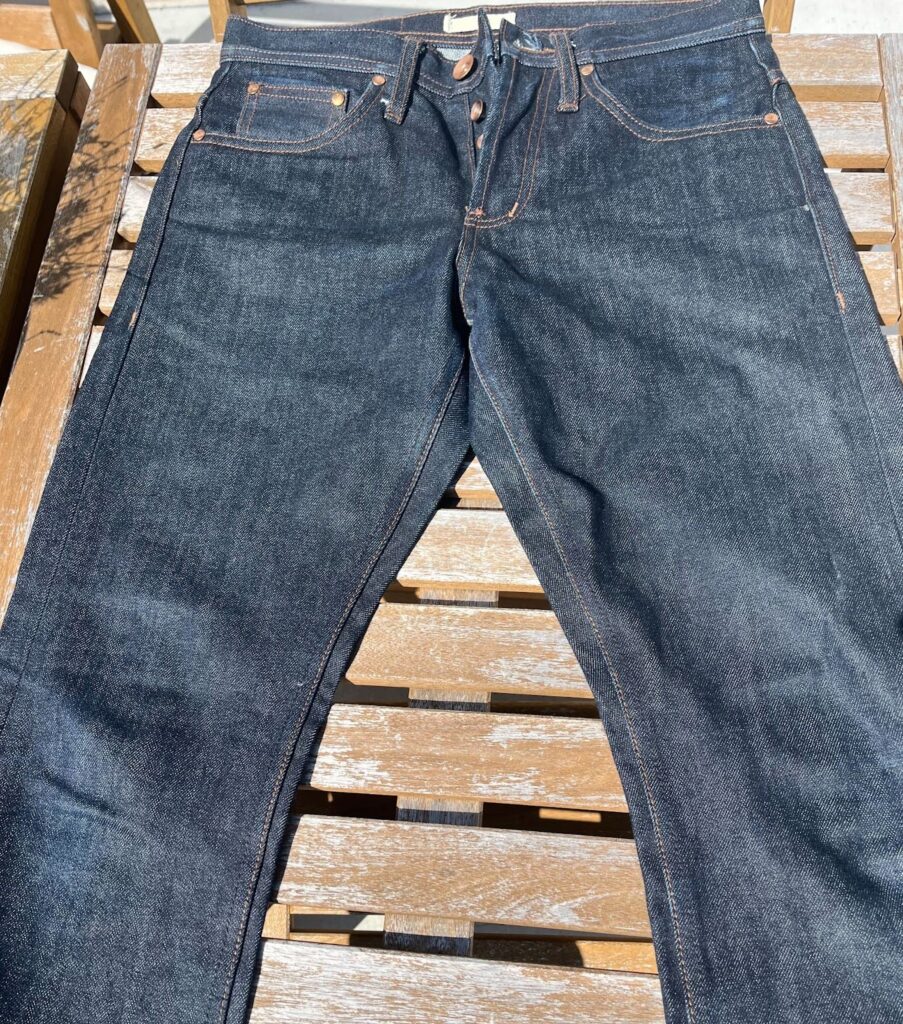
Not this*:
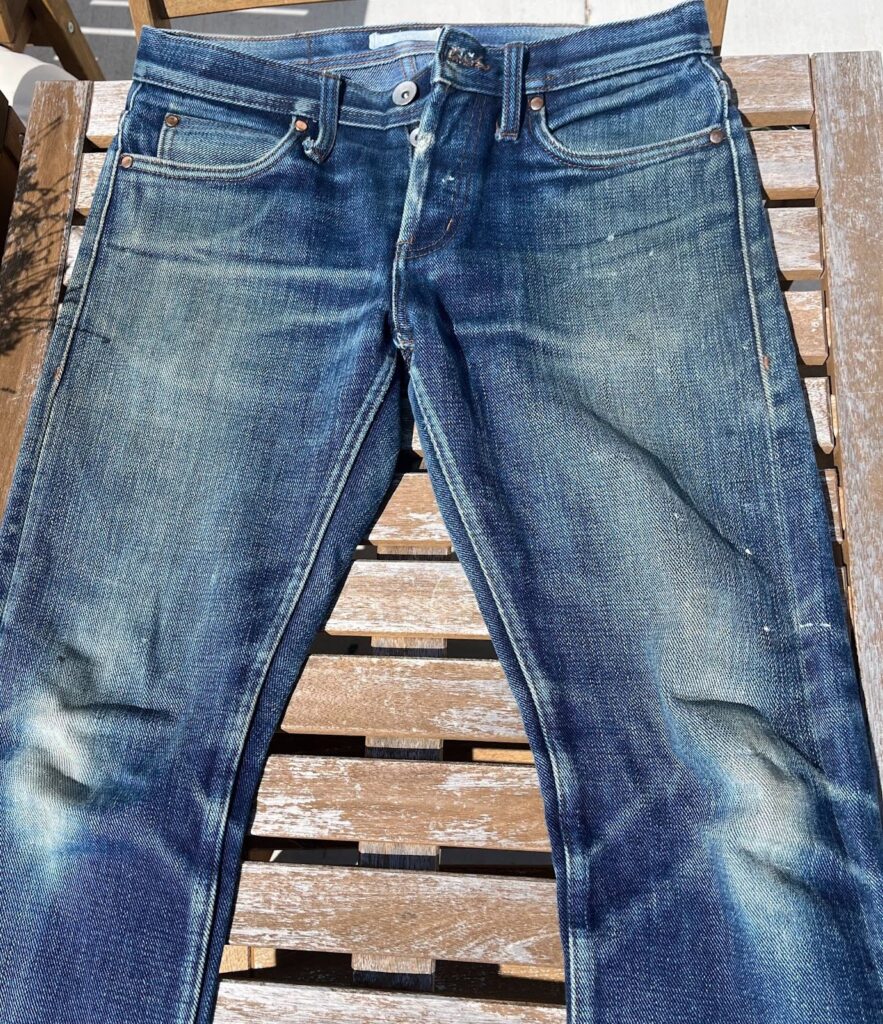
*Both of these are actually the same model of 21oz Unbranded brand denim, just at different stages of wear. I barely wore the darker ones before getting too fat for them, and I earned the fades and distressing on the lighter pair over a year or so of continual wear…. Before I got too fat for them, too.
What To Consider In 2025-2026
I don’t know too many people who are feeling absolutely flush with cash these days. Housing prices have gone up astronomically over the last 5 years, people are in a panic as their groceries get rung up, and it just feels like everything in life is trying to pull more money out of your wallet. So why not just get the cheapest jeans you can? Glad you asked:
Generally speaking, raw denim is a little more expensive than blown up, pre-distressed denim. Which is weird, considering how much more effort goes into preparing those jacked up jeans that you see all over the mall (I assume – I haven’t been to a mall in a really long time).
Although, going back to American Eagle: their most expensive men’s denim in a comparable fit to something I would buy are coming in at the $80 dollar mark (but currently on sale) and they look like hell.
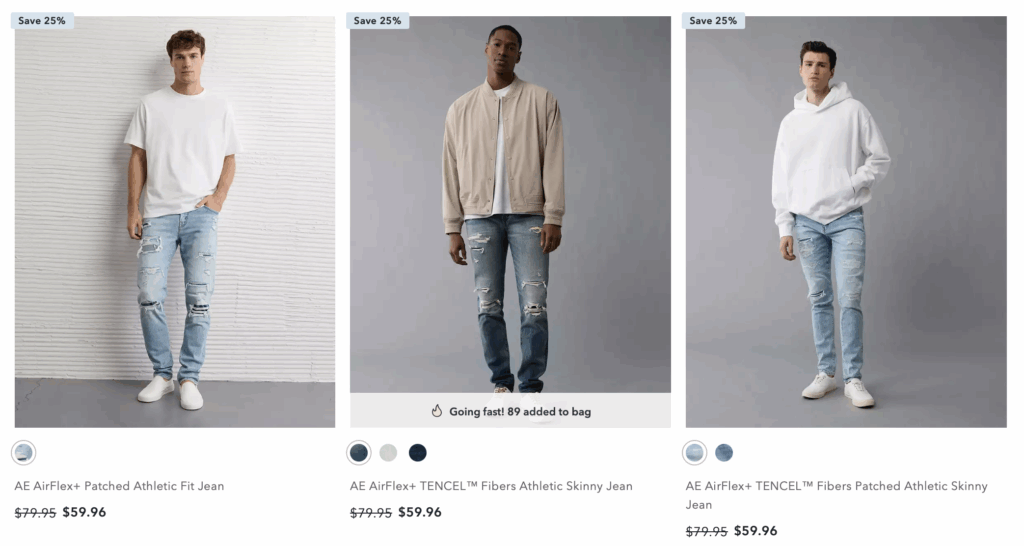
Still, in the world of raw denim (especially selvedge raw denim), $80 would generally be considered a steal. I get I’m not really selling my point of view that raw denim is the “value” play, but hear me out.
Imagine you spend $76 on a pair of jeans with holes in the knees from the factory. What are the chances that one day while getting ready in a hurry, you catch your big toe in the knee hole and instantly turn them into $80 jorts? Pretty high. Best case, you’re buying jeans with more than half their lifespan spent getting thrashed on the factory floor – even just washing them and tossing them in the dryer is putting a ridiculous strain on the remaining fibers.
On the flip side, let’s say you spend $100 on a pair of solid 12oz+ raws with no distressing. Unless you’re falling off of motorcycles, fighting bobcats, or gaining a ton of weight (like me), those things are going to last you for years. Personally, I would rather grit my teeth and spend $100 today and be set for the next 2 years than pay $80, watch my jeans disintegrate over the next 3 months, and be right back where I started.
Now, raw denim can get way more expensive than $100. But I’m going to cap us there as I show you some of your best options within that budget.
The Unbranded Brand UB01
These things are great. No, they aren’t as insanely beefy as the 21oz model I shared above, but I’ve had plenty of pairs of these 14.5oz wonders over the years as well. At a cool Benjamin, you really feel like you get your money’s worth in terms of fabric. And, you get blue selvedge ID instead of the standard red, which I think is kind of cool.
Now, they do carry a couple of important caveats: I’ve lost rivets and buttons on probably every pair I’ve ever owned. The fabric and general construction is solid as can be, but those more ancillary pieces can be flimsily installed. Fortunately, you really don’t need the exterior rivets, and it’s very easy to replace waistband buttons with a $6 kit like this.
The Bronson MFG. Co / Non Stock Mfg. Co.
Bronson is an interesting company: they’re a Chinese manufacturer specializing in vintage, mostly-military-inspired menswear. Their selvedge raw denim claim to fame is that they have replicas of the Levi’s Vintage Collection archives at a fraction of the cost of real Levis, while maintaining (if not improving upon) the LVC versions’ quality. Unfortunately, those Bronson replicas are a little outside of our self-imposed $100 cap. But wait – there’s more!
Bronson’s subsidiary brand, Non Stock Mfg. Co. has some pretty killer offerings on paper*. Check out these hearty 15 oz guys at only $69.99 – that leaves you enough cash to grab a taco if you choose these over the AE monstrosities I showed you above.
*Now, there is one important disclaimer: I’ve never owned a pair of Bronsons or Non Stocks. I’ve heard really good things just from being around the denim world, but I can’t give my full Daniel Seal of Approval without having owned a pair myself.
Gap
Look. I can feel you wanting to laugh. And to be honest, I almost didn’t include these over fear of losing credibility. That said, I have had many pairs of Gap selvedge raw denim over the years, and it’s hard for me to discount my experience – especially the discounting experience.
At full price, you’re getting some unmolested 13 oz denim for $99. But they’re never full price. At time of writing, they’re $69 even. But I can’t tell you how many times I’ve gotten them in the $50ish range. And at that price, you just can’t go wrong.
Now, the quality has definitely diminished over the years. It used to be that you were getting legitimate Japanese denim from Kaihara Mills. I don’t have a clue where these new ones are coming from, but they don’t feel as stiff, as starchy, or as high quality on the whole. But again, at that $50 range, they’re just an unbeatable deal.
Honorable Mentions: Levi’s 501 Shrink-to-Fit
501 Shrink-to-Fit don’t quite represent the budget option they once did now that they’re at $70-80 per pair, but like Gap, they do tend to go on sale. But be warned: there’s a learning curve with these jeans. Unlike pretty much every other option I’ve shared so far, these are “unsanforized,” which means the size you pull off the rack is nowhere near the size it’s going to be after you wash them (or get caught in a heavy rainstorm). This is a feature, not a flaw. It’s like a rite of passage for denim heads, and one I would encourage anyone to go through.
Here’s the process that I like to follow:
- Buy a pair that fit you a tiny bit looser than you would prefer, and a whole lot longer. My inseam is about 31”, but I would get a size 34” or even 36” inseam on STF jeans so I still had room to cuff. There’s no selvedge edge on standard, “cheap” 501s, though, so be prepared for a very plain cuff.
- Put the jeans on, draw a hot bath, and hop in WHILE WEARING YOUR NEW JEANS!
- Sit there for a while, smell the soup of dye and starch you’re making, then get up and wear them around until they dry and shrink. This ensures they shrink to your body, not just shrink to a size you can barely squeeze into.
If you size appropriately, you’ll wind up with maybe the best fitting pair of jeans you’ve ever had – because they were molded to your actual body. Custom jeans for under $100 isn’t a bad deal, if you ask me!
So What Is The ROI?
It’s hard to quantify a numerical return on investment, but here are some of the benefits I see in making the move toward raw denim this Fall:
- Look timeless and awesome
- Don’t seem like a desperate Sindey Sweeney simp
- Tap into Americana
- Get some pants that go with everything and aren’t going to just fall apart after a couple of weeks
- Develop fades and distress that serves as a reminder of your (now) awesome life
Seems like a fair trade for $100.